

As online platforms face growing pressure to protect minors and comply with evolving regulations, the challenge of verifying users' ages without compromising personal privacy has become a critical issue. France is now testing a groundbreaking solution that could redefine how digital identity and age verification are handled. At the center of this effort is France Identité, a state-developed application proposing a secure, anonymous, and technically advanced approach to confirming users' age eligibility for access to online services
The question of how to verify a user’s age without compromising their privacy or disclosing their full identity has emerged as a pressing issue within the broader debate surrounding online safety, digital rights, and data governance in France. As government bodies intensify efforts to regulate and restrict minors’ access to potentially harmful digital environments, including social media platforms and, increasingly, Virtual Private Networks (VPNs), the need for a robust, secure, and privacy-preserving method of online age verification has become increasingly evident.
Until recently, the available solutions for age verification relied on invasive or unreliable mechanisms such as facial recognition technologies, the submission of official identity documents, or loosely enforced self-declaration protocols. These approaches either presented significant privacy risks, failed to gain public trust, or lacked the technical rigor required for effective enforcement. In this context, the emergence of a new feature within the France Identité application, developed under the auspices of the French government, marks a potentially transformative step toward reconciling digital identity management with user privacy.
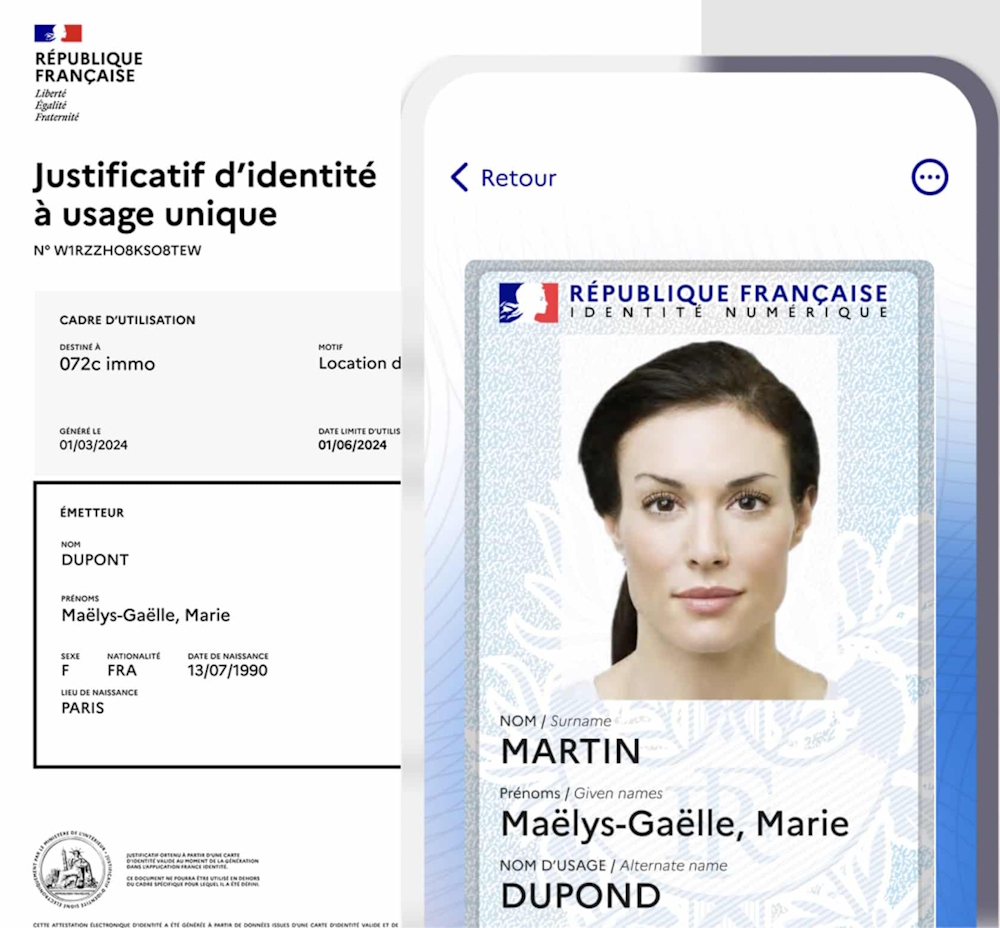
France Identité is a state-backed mobile application that already enables citizens to store and manage certain official documents in digital format, including the national identity card and driver’s license. Building on this foundation, the platform is currently piloting a new functionality that allows users to generate certified age proofs indicating whether they are over the age thresholds of 15 or 18 years. This proof does not disclose any other personal information. The design of the system is such that the online service requesting age verification receives only a binary response, either a positive confirmation that the age requirement is met or a denial, with no access to the user’s name, date of birth, or any other identifying attribute.
At the core of this system lies the principle of what developers describe as “double anonymity.” This cryptographic architecture ensures that neither party in the transaction, neither the requesting online service nor the issuing state authority, can correlate the age verification request with the individual’s complete identity or online behavior. On the one hand, the French government does not track or store information about which websites or digital services are requesting age verification. On the other hand, the digital service provider obtains no civil identity data beyond the certified age threshold result. This dual-blind structure represents a significant advancement in privacy engineering and reflects a broader trend in Europe toward the development of verifiable credentials that preserve user anonymity by default.
Technically, the system leverages the Near Field Communication (NFC) chip embedded in France’s new biometric national identity card, which conforms to the format and size of a standard bank card. This chip allows the France Identité application to access and verify the data stored on the ID card securely and locally on the user’s device. Once verification is complete, the app generates a cryptographic proof of age that can be validated by the requesting service through a secure digital signature process. Importantly, the architecture is designed such that no personal data is transmitted or retained during this transaction. According to the development team behind France Identité, no trace of usage is stored on either end, thereby preventing the accumulation of centralized databases that could be exploited to profile users or monitor their digital behavior.
The implementation of this system is not only a technical endeavor but also a politically significant experiment in sovereign digital identity. France, like other European Union member states, is navigating a complex regulatory landscape defined by the General Data Protection Regulation (GDPR), the proposed eIDAS 2.0 framework, and emerging national laws on online safety and digital content moderation. In this context, France Identité’s age verification functionality could become a cornerstone in the architecture of compliant, scalable, and trustworthy identity services that align with European values of privacy, transparency, and individual control over personal data.
Nevertheless, several logistical and structural challenges remain. Chief among them is the fact that access to France Identité’s advanced features depends on possession of the new generation of French electronic identity cards. As of now, not all citizens possess this updated document, and the process of renewing or replacing older ID cards varies significantly by region, with delays potentially impeding equitable access to the digital system. This introduces a potential barrier to adoption, particularly among marginalized populations or those living in underserved territories.
Moreover, the successful deployment of this privacy-centric age verification tool will hinge not only on technical feasibility and regulatory alignment but also on public trust and user acceptance. Digital identity systems, particularly those associated with state infrastructure, often evoke concerns related to surveillance, data misuse, and erosion of civil liberties. The France Identité project, by foregrounding anonymity and minimizing data retention, appears acutely aware of these concerns. However, long-term adoption will require continued transparency, rigorous oversight, and broad-based communication efforts to ensure that citizens understand the safeguards in place and the benefits of transitioning to a sovereign digital identity model.